
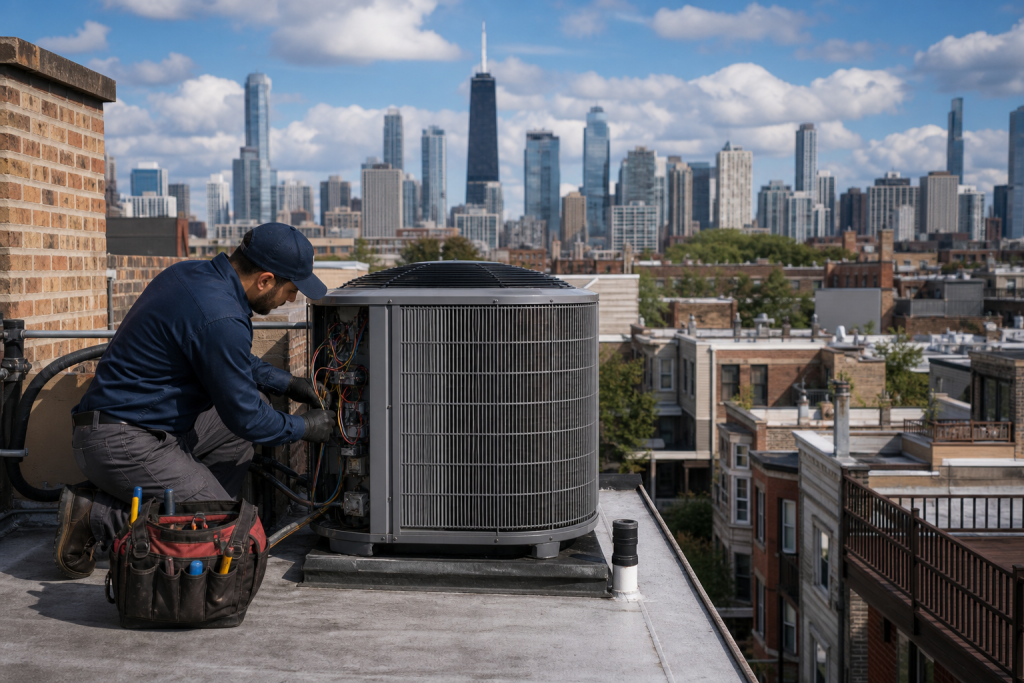
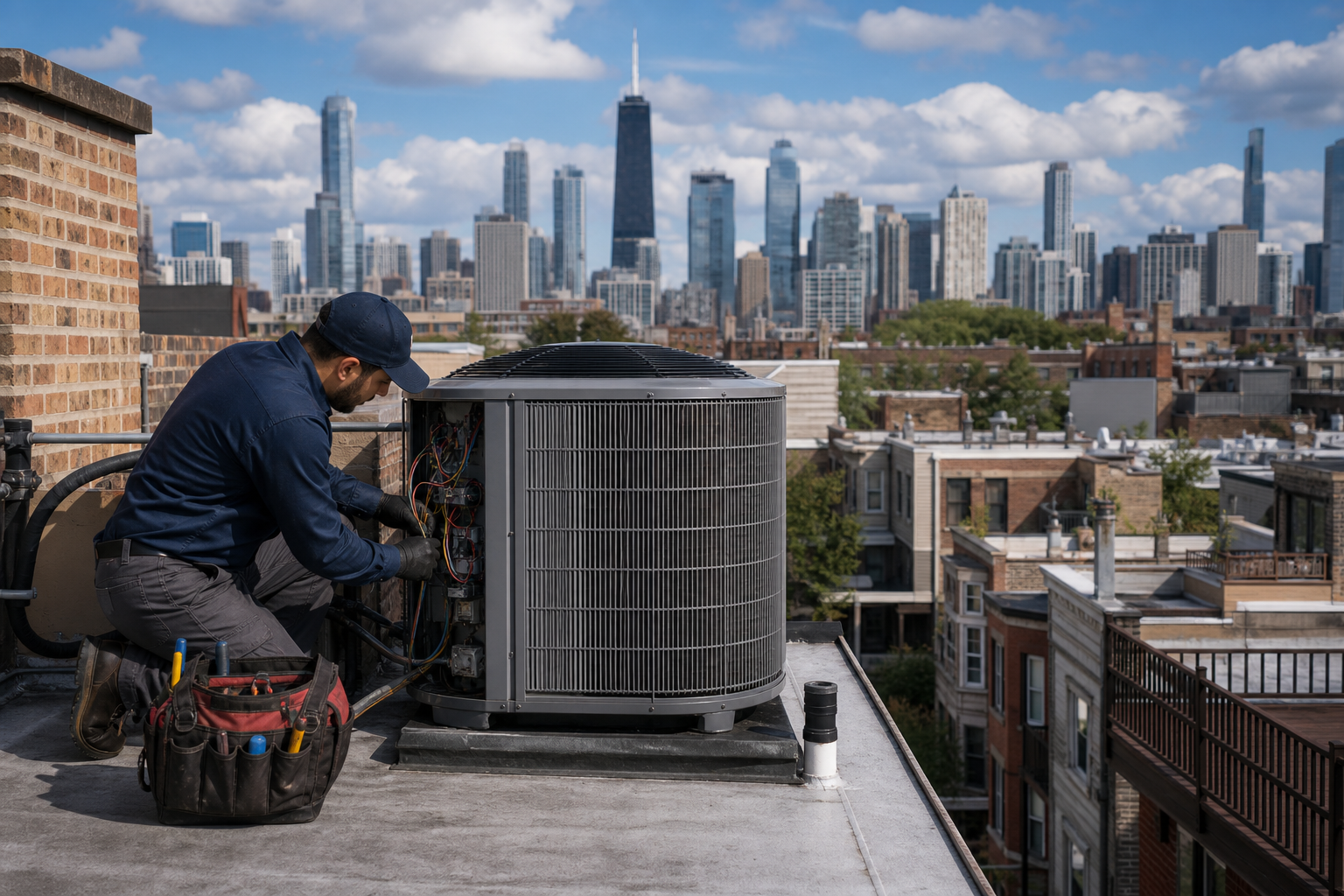
Trane AC Repair & Installation in Chicago: A Homeowner’s Guide
Trane AC repair and installation in Chicago typically runs $180-$450 for common repairs and $4,800-$9,200 for full system replacement, depending on model tier and home layout. Chicago’s hard water, basement-dominant installs, and high-humidity summers create failure patterns that differ from Trane’s national averages. If you’d rather sort this out with a technician who’ll give you straight numbers, call us at (833) 983-1671.
Trane’s “up to 10-year warranty” has an asterisk most homeowners don’t read until they’re standing in a hot house in July. That warranty requires registered installation by a qualified dealer within 90 days of purchase, and in our 42 years of work across Chicago, we’ve seen too many installs miss that window because the paperwork got “handled later.” By the time the coil fails, the homeowner is holding a parts bill that should have been covered.
Why Chicago’s Humidity Wears Out Trane Coils Faster Than the Brochure Says
Trane publishes evaporator coil lifespan estimates based largely on Sun Belt data, where dry climates let aluminum fins breathe easier. Chicago doesn’t cooperate with that math.
Our summers hang in the 70-80% humidity range for weeks at a stretch. That moisture condenses on the indoor coil, runs down the fins, and mixes with minerals from our hard water supply. Over five to seven years, that combination eats pinholes in the copper tubing. We’ve replaced Trane coils in Portage Park homes that were seven years old, and coils in Oak Park that made twelve. The difference was usually whether the homeowner had kept up with filter changes and whether the condensate drain was sloped properly.
Here’s what shortens coil life in Chicago specifically:
- Hard water scaling on the condensate pan, which backs up moisture against the coil cabinet
- Oversized systems that short-cycle and never reach steady-state humidity removal
- Basement installs with poor return air pathways, causing the coil to run colder than designed
- Neglected filter changes that let dirt embed in the fins and hold moisture
We check coil condition on every seasonal tune-up. Sometimes a deep clean and a condensate line flush buys you two more seasons. Sometimes the pitting has gone too far. Either way, we’ll show you what we’re seeing and explain whether repair or replacement makes sense for your situation.
The Registration Deadline Trap: How to Verify Your Trane Warranty
This is the one that hurts. Trane’s extended parts warranty, the one that covers that expensive compressor or coil, requires online registration within 90 days of installation. Miss it, and you’re back to the base 5-year coverage.
Here’s the problem: in Chicago’s market, a lot of Trane units get sold through wholesale channels to installers who aren’t Trane Comfort Specialists. The unit goes in, the homeowner gets a handshake and a business card, and nobody mentions registration. Or the installer registers the unit under their own dealer account, not the homeowner’s name, and when that dealer closes shop or changes brands, the warranty record becomes a ghost.
What to check right now:
- Find your model and serial number on the outdoor unit’s nameplate
- Call Trane’s warranty line or use their online lookup tool with your home address
- Confirm the install date matches your records and the registration is in your name
- If it’s missing or under a dealer you don’t recognize, call a Trane Comfort Specialist to re-register if possible, or at least document the gap
We handled a call last summer from a homeowner in Beverly whose 6-year-old XV18 compressor had failed. The unit was never registered. The replacement compressor cost $1,800 in parts alone. A 10-minute registration check in 2018 would have covered it.
When we install Trane in Chicago, we register the unit before we leave your driveway and give you the confirmation number in writing. No “we’ll take care of it later.” Later is how warranties die.
Basement Installs: Chicago’s Mechanical Room Reality
Most Chicago homes, especially the bungalows and brick two-flats built from the 1920s through the 1960s, put the furnace and coil in the basement. That creates specific airflow challenges for Trane’s design.
Trane’s variable-speed systems, particularly the XV and XL lines, are engineered for longer run times at lower capacity. That efficiency depends on a return air pathway that doesn’t choke the blower. In a typical Chicago basement, the return trunk runs low across the ceiling, makes two 90-degree turns, and often has a filter grille sized for a smaller system than what’s installed now. The blower works harder, the motor runs hotter, and the efficiency you paid for disappears into ductwork losses.
Before any Trane install in Chicago, we measure static pressure across the coil and verify the return pathway can support the system’s designed airflow. Sometimes that means adding a second return grille. Sometimes it means reworking the trunk. We’ll tell you before we quote, not after we’ve started.
Attic installs, common in newer construction or raised ranches, have their own issues: summer heat load on the refrigerant lines, condensate pumps that fail silently, and access hatches that discourage maintenance. Closet installs in condos, typical in Lincoln Park or Lakeview high-rises, need combustion air verification and sometimes sound attenuation. Each location changes what a proper Trane install requires.
Which Trane Model Tier Makes Sense for Chicago’s Cooling Season
Trane organizes its residential line into XR (single-stage, entry), XL (two-stage, mid), and XV (variable-speed, premium). The national marketing pushes variable-speed as the smart choice everywhere. For Chicago, we’d push back, gently.
Chicago’s cooling season runs roughly late May through early September, about 120 days of meaningful AC use. A homeowner in Phoenix runs their system 240+ days. The payback math on a $2,500-$4,000 premium for XV-level efficiency stretches differently across 120 days versus 240.
Our experience across Chicago neighborhoods:
- XR14 or XR16: Sensible choice for homeowners planning to sell within 5-7 years, or for second-floor additions with limited runtime. Reliable, straightforward, repairable by any competent technician.
- XL16i or XL18i: The sweet spot for most Chicago homeowners staying put. Two-stage operation handles our humidity spikes better than single-stage, and the efficiency improvement pays back over 10-12 years at ComEd rates.
- XV18 or XV20i: Worth the premium if you’re in a home with excellent ductwork, planning to stay 15+ years, or have specific humidity concerns (finished basements, mold-sensitive family members). The variable-speed compressor is excellent machinery, but it needs proper airflow to deliver its rated performance.
We also service and install heat pump and mini-split systems in Chicago for homes where ductwork modifications aren’t practical. Sometimes a Daikin or Bryant mini-split for the problem room pairs better with keeping your existing Trane central system than ripping everything out.
What a Legitimate Trane Dealer Quote Must Include
Price-match gimmicks are common in Chicago’s HVAC market. A company quotes low, omits the permit, skips the load calculation, and sends a subcontractor in an unmarked van. Six months later, you’re calling someone else to fix the refrigerant charge and the sagging line set.
A proper Trane installation quote should include these items without you having to ask:
- Manual J load calculation for your specific home, not a square-footage rule of thumb
- Static pressure testing and ductwork modification plan if needed
- Refrigerant line set inspection or replacement specification
- Electrical disconnect and breaker verification
- City of Chicago permit and inspection scheduling
- Trane unit registration in your name, with confirmation
- Written warranty terms for both equipment and labor
- Final walkthrough with thermostat programming and filter-change schedule
We pulled a unit out of a garage over in Albany Park two years ago where the previous installer had set a 3-ton Trane on a 2.5-ton duct system. The coil froze solid every July, the homeowner blamed Trane, and the original contractor had vanished. A proper load calc would have caught it. We installed a right-sized XL16i, reworked the return, and the homeowner hasn’t called back except for annual maintenance.
Our AC repair and installation in Chicago includes all of the above, priced upfront. The number we give you is the number you pay. If we find something unexpected, we stop and talk before proceeding.
When to Call a Pro
If your Trane system is blowing warm air, cycling rapidly, or making grinding noises from the outdoor unit, turn it off and call. Running a failing compressor can turn a $400 repair into a $2,000 replacement. For refrigerant leaks, electrical faults, or any issue involving the sealed system, EPA-certified handling is required by law, and the diagnostic equipment pays for itself in accurate repair versus replace guidance.
We answer calls 24 hours a day, every day, including holidays. Live person, no voicemail tree. If it’s 2 a.m. and your Trane has quit, we’ll talk through whether it’s safe to wait until morning or if we need to roll a truck.
Related Services in Chicago
Beyond Trane-specific work, we also handle heating and furnace service in Chicago for the other half of the year. Many of the same airflow and sizing principles apply. If your home’s mechanical systems are original to a 1950s build, a whole-system assessment often saves more than piecemeal repairs.
What happens when you call
- 1
A real person answersNo phone trees - you reach a local pro.
- 2
You get an upfront price rangeHonest numbers before anyone is dispatched.
- 3
A background-checked tech heads outLicensed & insured, dispatched right away.
- 4
You approve before work beginsNothing starts until you say go.
The Bottom Line
Trane builds durable equipment, but Chicago’s conditions, hard water, basement-dominant installs, and shorter cooling season mean the national playbook needs local adjustment. Verify your warranty registration. Size the system to your ductwork, not just your square footage. Choose the model tier that matches how long you’ll stay and how you’ll use it. And get every promise in writing, including what happens if something isn’t done right the first time.
At Fireside Heating & Air Co., our 90-Day Done Right Promise means if it’s not right, we make it right, in writing, no paperwork, no arguing. We’ve been serving Chicago homeowners since 1984, and most of our calls come from people who’ve been let down once and don’t want to go through it again.
If you’re in Chicago and need help with your Trane system, we offer free estimates. Call (833) 983-1671. We’ll give you straight talk about what your system needs and what it will cost.
Frequently Asked Questions
Most Trane AC repairs in Chicago fall between $180 and $450, with capacitor or contactor replacements on the lower end and compressor or coil work on the higher end. Refrigerant leaks add $200-$600 depending on location and accessibility. We offer $50 off any repair over $250, and our estimates are free. Call (833) 983-1671 for exact pricing on your specific unit.
If your Trane AC is under 8 years old and the repair is under $1,000, repair usually makes sense. Between 8 and 12 years, weigh the repair cost against the system’s remaining efficiency and any pending refrigerant phase-out (R-22 systems are now expensive to recharge). Over 12 years, replacement often wins on reliability and operating cost. We give straight repair-versus-replace guidance on every call, no pressure either way.
Same-day installation is possible for emergency replacements during our peak season, but we prefer to measure, calculate, and quote properly, which typically takes 24-48 hours. Rush installs without load calculations are how systems end up oversized and inefficient. For true emergencies, call (833) 983-1671 and we’ll work out the fastest safe timeline.
Check your model and serial number against Trane’s online warranty lookup or call their warranty department with your install address. Confirm the unit is registered in your name, not a dealer’s, and that the install date is accurate. If you find gaps, a Trane Comfort Specialist may be able to help document the original install date. We register every unit we install before leaving the job and give you the confirmation number.
Written by the team at Fireside Heating & Air Co. of Chicago, serving Chicago since 2015.
Need HVAC Help?
Call Fireside Heating & Air Co. of Chicago - licensed & insured, here with fast after-hours help in Chicago.
(833) 983-1671