
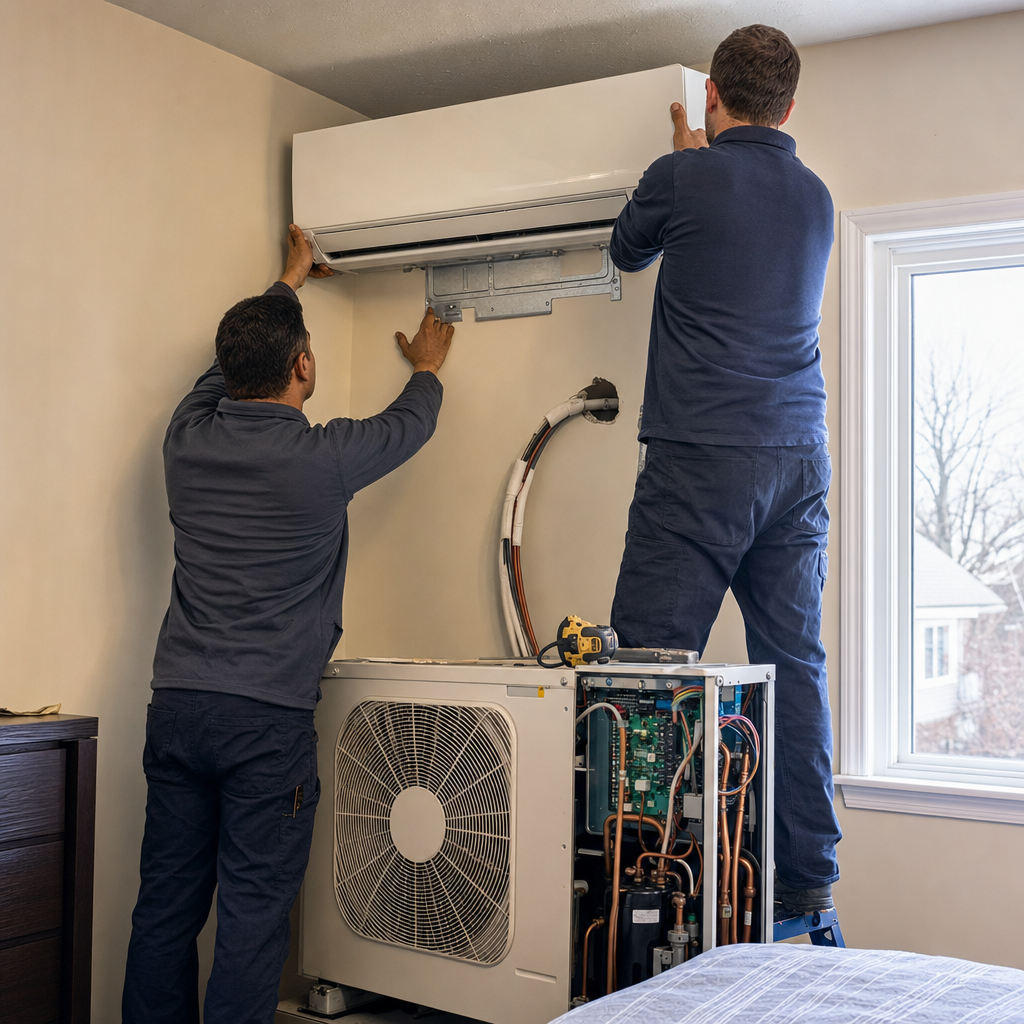
American Standard Mini-Split Installation: The Chicago Owner’s Guide
American Standard mini-split installation in Chicago typically runs $3,500-$7,500 for a complete single-zone system, and we stock the line sets, mounting brackets, and communication cables for same-day starts on most jobs. Most homeowners realize their current mini-split needs replacing when the compressor locks up after a brutal August heat wave, or when a fifteen-year-old system starts blowing lukewarm air through a Norwood Park bungalow that never had ductwork to begin with. Tell me what it’s doing, and I’ll tell you what it needs.
Which American Standard Models This Applies To
We install across American Standard’s full mini-split lineup: the 4TXM6 Multi-Zone, the 4TYK6 Single-Zone, and the 4TTK6 Heat Pump series. The critical match point is the outdoor unit’s BTU rating paired to the indoor head count, not just the brand badge on the cover. A 4TXM6-24K outdoor unit, for instance, handles two to three indoor heads depending on their individual loads, and mismatching head capacity to the outdoor compressor is where Chicago homeowners get into trouble after a handyman special.
Check the silver data plate on the outdoor unit’s right side for the model prefix. The “4T” denotes American Standard’s ductless family. For parts compatibility, we cross-reference the R-410A or R-32 refrigerant spec, which matters because mixing refrigerant types ruins the compressor and voids what warranty remains. We carry OEM flare nuts and line sets sized to American Standard’s exact torque specs, though we also source quality aftermarket equivalents from Parker and Yellow Jacket when the job calls for it. The difference shows up in vibration resistance on those metal roof mounts common in Bridgeport and Pilsen.
Fireside Heating & Air Co. of Chicago is an independent service provider, not affiliated with American Standard.
Signs Your American Standard Mini-Split Installation Is Failing
- Weak or lukewarm airflow from the indoor head. This usually traces to a refrigerant leak at the flare connection, which Chicago’s freeze-thaw cycles aggravate as aluminum line sets contract and expand. The system runs constantly without reaching setpoint, and your ComEd bill climbs.
- Water dripping from the indoor unit or staining the wall below. The condensate pump fails or the drain line clogs with algae, common in humid July weather when the unit never cycles off. Left alone, it rots plaster in those 1920s Chicago frame homes with no vapor barrier.
- Loud grinding or clicking from the outdoor compressor. The inverter board or compressor bearings are failing, often after power surges from summer storms rolling off Lake Michigan. American Standard’s inverter-driven compressors are precise equipment, and voltage fluctuation kills them faster than steady overload.
- Error codes flashing on the indoor display, especially E1, E4, or F0. These point to communication faults between head and compressor, usually from corroded terminal blocks or rodent damage to low-voltage wiring in crawl spaces. We’ve pulled nests from condensers in Garfield Ridge more than once.
- System short-cycles or won’t start after winter layoff. The capacitor degraded in cold storage, or the crankcase heater never worked and liquid refrigerant pooled in the compressor. Chicago’s shoulder seasons punish equipment that sits idle.
Replacement Cost & What’s Included
A full American Standard mini-split installation in Chicago runs $3,500-$7,500 for single-zone systems, with multi-zone jobs climbing from there based on head count and line set length. That range covers the outdoor unit, indoor head, refrigerant lines, electrical whip, disconnect, pad or wall bracket, and all labor including evacuation and charging to factory spec.
What moves the needle: longer line sets for second-story installations in Lincoln Park greystones, electrical upgrades from fuses to breakers in older Portage Park bungalows, and permit fees that vary by municipality, Chicago proper included. We pull permits where required, handle the inspection scheduling, and warranty our work for 90 days under the Done Right Promise. The price we quote is the price you pay. No surprises when the job’s half done.
We also service Carrier, Trane, and Lennox mini-splits with the same journeyman standard.
DIY or Call Us?
There’s a short list of what a careful homeowner can check before calling: verify the breaker hasn’t tripped, clean the indoor filter, and confirm the remote’s batteries and mode setting. Beyond that, mini-split work involves brazing copper with nitrogen purge, pulling a vacuum to 500 microns, and charging refrigerant by weight, not pressure. Get any of that wrong and you’ve voided the warranty and possibly contaminated the system.
The electrical side carries real hazard, too: 240V outdoor disconnects and inverter boards that hold lethal capacitance after power-down. Terry Kowalski learned early at Olive-Harvey College that respect for the equipment keeps you alive in this trade. If your American Standard mini-split is showing the symptoms above, call (833) 983-1671. We’ll give you straight talk about repair versus replace, and if installation makes sense, we’ll quote it upfront and be there when we say.
FAQs
Expect 12 to 15 years with proper maintenance, though we’ve seen them fail at 8 when neglected and stretch past 18 with annual cleanings. The lake-effect humidity and road salt corrosion in near-lake neighborhoods like Edgewater take a measurable toll on outdoor coils. Call (833) 983-1671 to schedule an $89 seasonal tune-up and we’ll tell you honestly where your system sits in that range.
Often yes, if the compressor and coil are sound and the unit’s under ten years. A failed capacitor, contactor, or fan motor runs $150-$650 in our Chicago repair range, and we apply our $50 off any repair over $250. But if the system’s past 12 years and the refrigerant is R-22, replacement is the smarter money. We’ll give you both numbers and let you decide.
Most single-zone American Standard mini-split installations finish in one day, two at most if we’re running line sets through finished spaces or working around plaster and lath. Multi-zone jobs with three or more heads typically need a second day for testing and balancing. We don’t leave until the system holds temperature and you’ve seen the operation firsthand.
We stock common line sets, flare hardware, pumps, and electrical components on every truck, and we maintain relationships with Chicago-area distributors for next-day unit delivery on American Standard, Carrier, Trane, and Lennox. For planned installations, we order ahead and confirm the model serial before we arrive. Emergency replacements, we work with what’s available and never substitute without your okay.
Written by Terry Kowalski, Owner, Fireside Heating & Air Co. of Chicago at Fireside Heating & Air Co. of Chicago, serving Chicago and nearby areas.