
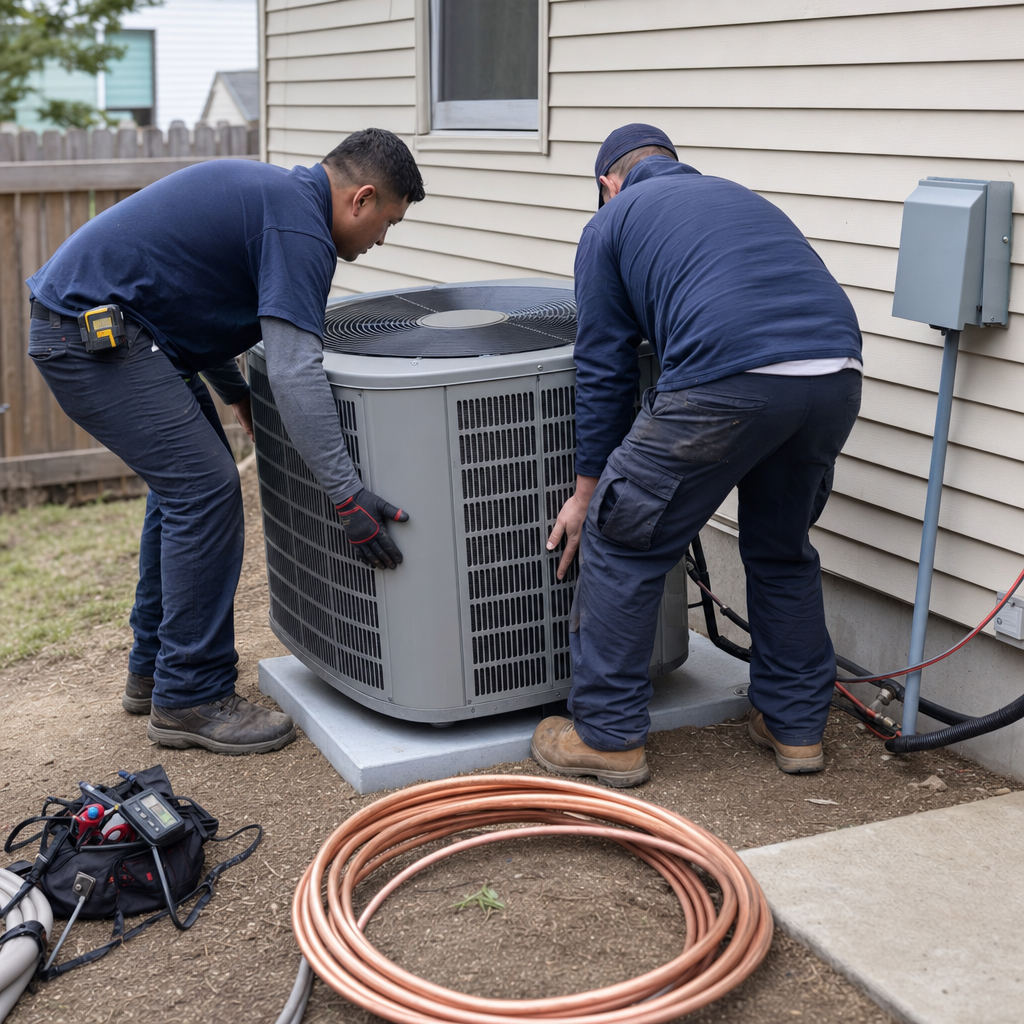
Goodman Mini-Split Installation: The Chicago Owner’s Guide
A complete Goodman mini-split installation in Chicago typically runs $3,500-$7,500 for a single-zone system, and we can usually get you on the schedule within 24-48 hours. Most Goodman units we install are the MSG series or the newer GVTC cold-climate lines, sized between 9,000 and 36,000 BTU depending on whether you’re conditioning a Bucktown bungalow bedroom or a full Ravenswood two-flat. Homeowners usually realize they need a new system when their current mini-split starts short-cycling in July humidity, blows lukewarm air while the condenser ices over, or simply quits after a dozen Chicago winters.
Which Goodman Models This Applies To
Goodman mini-splits fall into two main lines you’ll see around Chicago: the MSG standard-efficiency series and the GVTC cold-climate heat pump series rated to perform at 5°F and below. The MSG line runs from 9K to 24K BTU, single-zone only, with SEER ratings of 16-19. The GVTC line, what we recommend for anyone in Portage Park or Albany Park who needs real heat in January, spans 12K to 36K BTU and hits 22+ SEER with HSPF ratings that matter when it’s minus ten.
Here’s the compatibility gotcha: Goodman uses a proprietary digital communication protocol between indoor and outdoor units. You cannot pair a Goodman indoor head with a Mitsubishi or Daikin condenser, even if the refrigerant lines fit. The boards won’t talk. We’ve seen homeowners in Bridgeport learn this the hard way after buying “universal” heads online. Check the model plate on your outdoor unit, the one riveted to the service panel, not the sticker on the side. The first four digits tell you the series, the next two the BTU capacity. MSG09 is a 9,000 BTU standard unit. GVTC24 is a 24,000 BTU cold-climate unit.
For parts, we’re not affiliated with Goodman, but we source OEM compressors, inverter boards, and refrigerant valves through authorized distributors. We also carry quality aftermarket equivalents for certain components, fan motors especially, where the spec matches and the warranty holds. We’ll tell you which we’re using and why.
Signs Your Goodman Mini-Split Installation Is Failing
- Short-cycling or rapid on-off behavior. The inverter board is struggling to modulate compressor speed, often because voltage fluctuation on Chicago’s aging grid has damaged capacitors. You’ll hear the unit kick on, run ninety seconds, shut off, and repeat. This wears the compressor fast.
- Lukewarm air in cooling mode, or inadequate heat below 20°F. The refrigerant charge is low from a leak at the flare fitting, common in installations where thermal expansion and contraction weren’t accounted for through our freeze-thaw cycles. Goodman GVTC units should deliver usable heat to 5°F; if yours quits at 25°F, it’s a charge or valve issue.
- Icing on the outdoor coil in summer. The defrost sensor or reversing valve has failed, or the unit is simply undersized for the latent load of a humid July in Lincoln Square. The ice builds, airflow drops, and the head unit starves.
- Error codes flashing on the indoor display, especially E1, E5, or F0. E1 is communication failure between units, E5 is overcurrent protection, and F0 is refrigerant leak detection. Each points to a specific repair, but repeated codes after reset usually mean board-level replacement.
- Unusual vibration or grinding from the outdoor unit. The compressor mounts have degraded, or the scroll compressor itself is failing. Goodman uses Copeland scroll compressors in most units, solid equipment, but after 12-15 years of Chicago summers and winters, even they wear.
Replacement Cost & What’s Included
A full Goodman mini-split installation in Chicago runs $3,500-$7,500 for a single-zone system, with multi-zone setups climbing from there. What drives the range: the BTU capacity, whether we need to run new electrical from your panel (common in 1920s brick bungalows with 100-amp service), and how far the indoor head sits from the outdoor condenser. A straight back-to-back install in a newer Jefferson Park ranch costs less than a third-floor head in a Hyde Park greystone with fifty feet of line set and a pump-up drain.
Our price includes the unit, refrigerant lineset, electrical whip, disconnect, pad or wall bracket, and all labor. We pull permits through the City of Chicago Department of Buildings when required, which is any new outdoor unit or electrical work. No hidden charges. The price quoted is the price paid, full stop. Every installation carries our 90-Day Done Right Promise in writing, plus the manufacturer’s warranty, which is 10 years on parts when registered by a licensed contractor.
DIY or Call Us?
There’s a short list of what a homeowner can safely check: verify the breaker hasn’t tripped, clean the indoor filter, and make sure the outdoor unit isn’t blocked by leaves or snow. Beyond that, mini-split work involves 240-volt electrical, high-pressure refrigerant, and brazing with nitrogen purge, none of which forgive mistakes. The refrigerant itself is regulated; venting it is a federal violation, and handling it without EPA Section 608 certification exposes you to fines.
We’ve been called to homes in Avondale where a homeowner’s “simple” install turned into a $2,400 recovery and recharge because the lineset wasn’t evacuated properly and moisture destroyed the compressor. Tell me what it’s doing, and I’ll tell you what it needs. Call (833) 983-1671, and we’ll give you a straight answer and a free estimate.
FAQs
Expect 12-18 years with proper maintenance, though the outdoor fan motor and inverter board often need attention around year 10. Our freeze-thaw cycles and summer humidity are harder on electronics than milder climates. Annual tune-ups catch the small stuff before it becomes a full replacement.
Often, yes, if the unit is under 10 years old and the compressor is sound. A failed sensor, leaking flare, or bad board runs $150-$650 in repair. But if the compressor itself has failed and the unit is past year 12, replacement is usually the better spend. We’ll give you straight talk about repair versus replace.
Most single-zone installs we complete in one day, six to eight hours. Two-zone systems or jobs requiring new electrical service may stretch to a second day. We show up when we say, and we don’t leave until it’s running and you’ve been walked through the remote.
We keep common Goodman components on our trucks, including capacitors, contactors, and sensors. Full units we source through our distributor with next-day availability in most cases. For emergency no-heat or no-cool situations, we’ll get you running with what we have and finalize the permanent fix fast.
Written by Terry Kowalski, Owner, Fireside Heating & Air Co. of Chicago at Fireside Heating & Air Co. of Chicago, serving Chicago and nearby areas.