
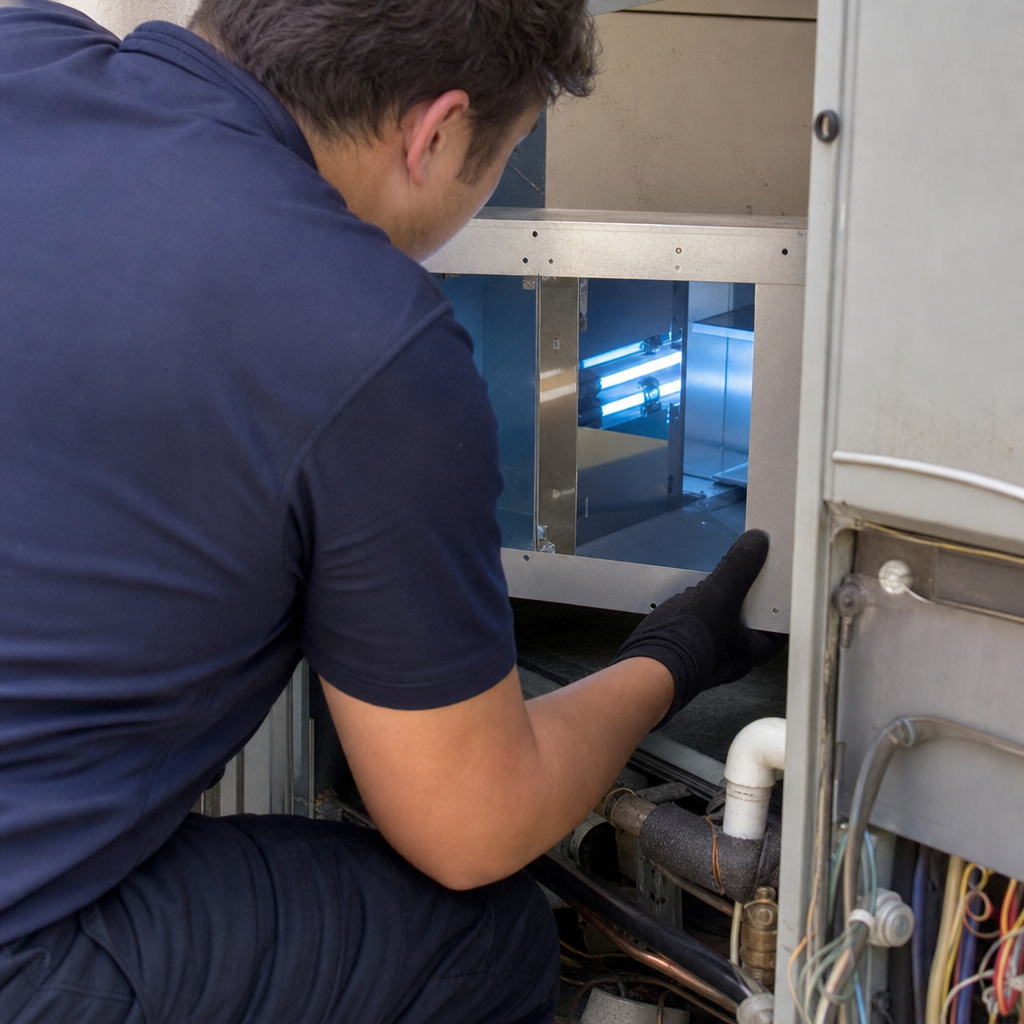
Carrier Ductwork Repair: The Chicago Owner’s Guide
Carrier ductwork repair in Chicago typically runs $150-$650 installed, depending on whether we’re sealing a section, replacing a collapsed run, or rebuilding a plenum connection. We stock Carrier-compatible sheet metal, flex duct, and plenum components on every truck, and most repairs are completed same day. You’ll usually notice the problem first as uneven heating between rooms, a sudden jump in your gas bill, or that thin whistling sound that starts every time the blower kicks on in January.
Which Carrier Models This Applies To
Carrier’s Infinity, Performance, and Comfort series all share the same ductwork interface standards, but the plenum dimensions and return-air sizing vary by tonnage. A 3-ton Infinity 26 heat pump needs a 20-by-20-inch return plenum minimum; drop below that and you’re choking the variable-speed blower Carrier designed to run at 300-1,050 CFM. We see this mismatch constantly in Chicago bungalows where a previous owner downsized the return to fit a basement closet.
Check your air handler or furnace label for the model prefix: 58MVB, 59TP6, or FE4ANF for the Infinity line; 58SB0 or FX4DNF for Performance. The duct collar sizes are stamped on the unit’s side panel. OEM Carrier plenum kits run 20-30% higher than quality aftermarket equivalents from Duro Dyne or Eastern Sheet Metal, and for standard galvanized connections we typically recommend aftermarket. Where we insist on OEM is the sealed combustion intake collar on 90%-plus furnaces, any part touching the heat exchanger, and the transition pieces on Infinity systems with the Infinity Air Purifier. Those interfaces are proprietary, and an ill-fitting collar voids the communication between the furnace and the zoning board.
Terry Kowalski, our owner, learned this the hard way in the late nineties on a job in Bridgeport where an aftermarket plenum leaked just enough to trip the pressure switch every third cycle. Took three callbacks to find it. “Tell me what it’s doing, and I’ll tell you what it needs” - that was the job that made it his standard greeting.
Signs Your Carrier Ductwork Repair Is Failing
- Uneven temperatures room to room. A collapsed flex duct run or separated main trunk damper sends all your conditioned air to the path of least resistance. In Chicago two-flats, we find this most often in the rear bedroom above the unheated porch, where a single 6-inch run was never adequate to begin with.
- Whistling or rushing air at registers. This usually means a duct boot has pulled away from the floor joist or a supply plenum seam has opened. The noise is air escaping at velocity, and every cubic foot leaking into your attic or crawlspace is money you’re burning.
- Dust plumes when the blower starts. A return duct with a gap in the basement or garage is drawing in unfiltered air. Carrier’s MERV-rated filters can’t catch what never passes through them, and that dust load will foul the indoor coil within two seasons.
- Ice on the indoor coil in summer or high limit trips in winter. Both point to restricted airflow from a crushed or kinked duct. Carrier’s ECM blowers will try to compensate until they can’t, then fault out. The compressor or heat exchanger takes the real damage.
- Spikes in heating or cooling costs with no rate change. A 15-20% jump often traces to a disconnected return in an unconditioned space. Your system runs longer to hit setpoint while reheating or recooling the same leaked air.
Replacement Cost & What’s Included
| Repair Type | Typical Range | What’s Included |
|---|---|---|
| Seal/reconnect single duct run | $150-$280 | Mastic sealant, mechanical fasteners, airflow test |
| Replace flex duct run (up to 25 ft) | $280-$450 | R6 insulated flex, collars, straps, balancing |
| Rebuild plenum or transition | $350-$650 | Custom sheet metal, OEM or spec-grade aftermarket, seal, test |
What drives the range is access and material. A basement ceiling run we can reach from a stepladder costs less than a crawlspace repair in a 1920s brick bungalow where we’re working on our backs. We quote upfront before any work starts, the price quoted is the price paid, and every repair is backed by our 90-Day Done Right Promise in writing. If it leaks, whistles, or doesn’t balance right, we make it right. No paperwork, no arguing.
DIY or Call Us?
There’s a short list of things a homeowner can safely check. Verify that floor registers aren’t blocked by furniture or rugs. Peek in the basement for obvious disconnected flex duct hanging loose. Listen for the whistle location and note which room gets no airflow. That’s the end of the safe list.
What goes wrong with DIY ductwork is invisible but costly. Mastic applied over dust or oil peels off in six months. A plenum rebuilt with hardware-store foil tape fails at the seam where temperature swings flex the metal. Worst is the homeowner who closes off “too many” supply ducts to force air to a cold room, not knowing they’ve just raised the static pressure enough to trip the high limit or slug the compressor with liquid. Carrier’s variable-speed systems are especially unforgiving of amateur airflow manipulation.
We’re not affiliated with Carrier, but we’ve installed and repaired their equipment since the early nineties. We know where the factory specs leave wiggle room and where they don’t. Call (833) 983-1671 and we’ll walk through what you’re seeing. Estimates are free, and most days we can be there within hours.
FAQs
Properly installed galvanized sheet metal lasts 30-50 years, but flex duct in unconditioned attics or crawlspaces degrades in 15-25 years due to our freeze-thaw cycles and summer humidity spikes. The real killer is vibration from poorly supported runs, which we see constantly in homes where the original installer used plastic zip ties instead of metal straps. Call (833) 983-1671 if you’re unsure of your duct age, we’ll inspect at no charge.
Seams, small holes, and disconnected collars can be repaired permanently with proper mastic and mechanical reinforcement. We replace rather than patch when the duct is crushed, the inner liner of flex duct is torn, or the plenum has rusted through at the furnace connection. Straight talk about repair versus replace: if we’d have to patch the same section twice, we’ll tell you that upfront and quote replacement.
Most single-run repairs or reconnections take 90 minutes to three hours. A full plenum rebuild in a tight crawlspace might stretch to a half day. We stock the common Carrier collar sizes, transition dimensions, and flex duct diameters on every truck, so we’re not losing time to parts runs. Most jobs are done in a single visit.
We stock Carrier-compatible plenum kits, transition pieces, combustion air collars, and the full range of flex duct and fittings. For proprietary Infinity-series components, we source OEM through our distributor same-day or next-morning. We’ve been doing this long enough to know what’s on the shelf and what isn’t, and we’ll tell you before we schedule.
Written by Terry Kowalski, Owner, Fireside Heating & Air Co. of Chicago at Fireside Heating & Air Co. of Chicago, serving Chicago and nearby areas.